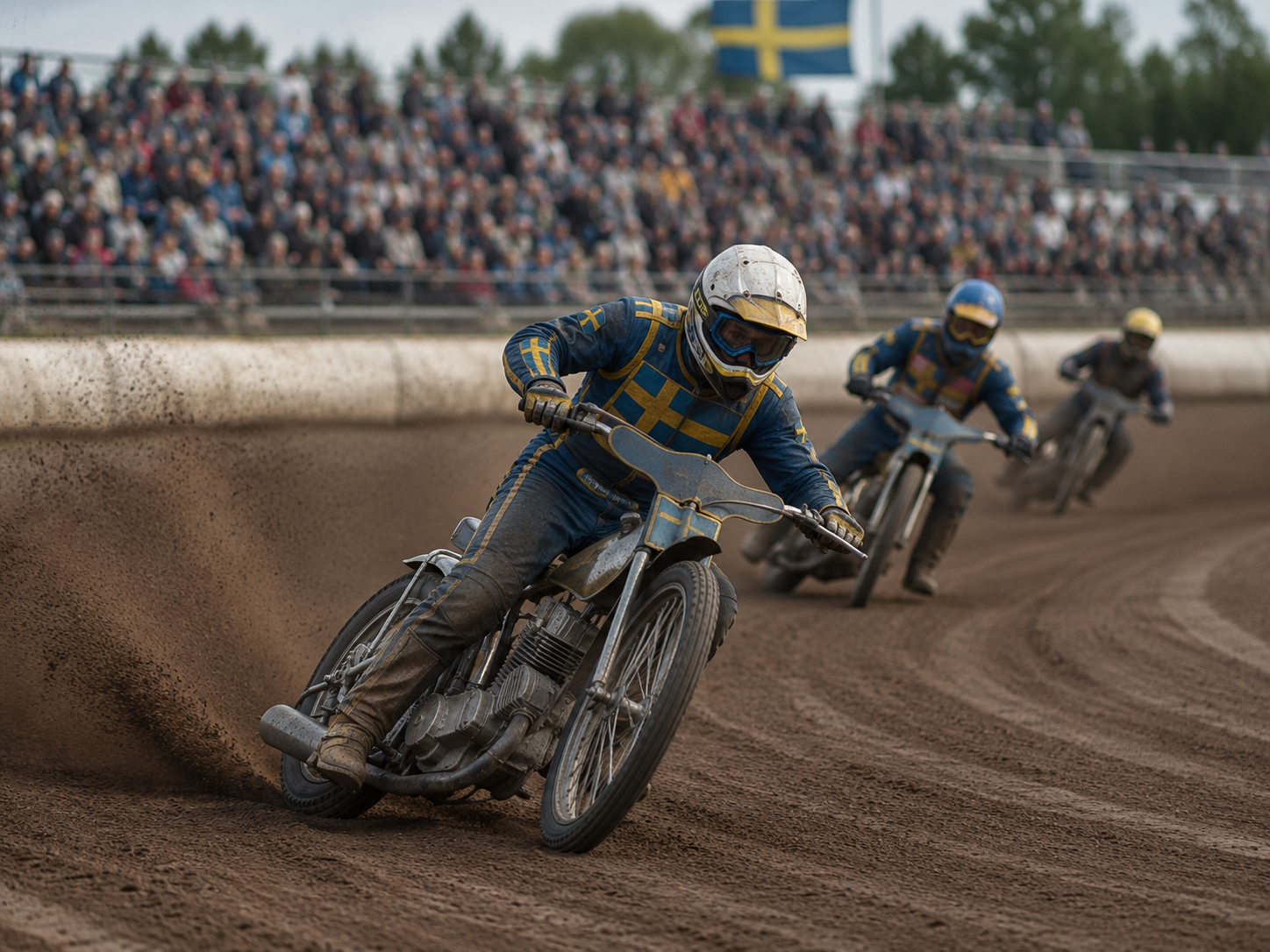
Swedish speedway history brings together world champions, historic league clubs, forest tracks, international riders, and generations of supporters.
The Roots of Swedish Speedway
Motorcycle speedway developed internationally during the first half of the twentieth century. Its core format was easy to recognize: compact oval tracks, loose racing surfaces, specialized motorcycles, rapid starts, and riders controlling the rear wheel through the corners.
As the discipline spread through Europe, Sweden developed a racing culture shaped by its geography and strong network of local motor clubs. Speedway meetings were not confined to the largest cities. Tracks and teams became associated with towns where racing could form an important part of local sporting life.
This local structure helped speedway grow as both an individual and team sport. Individual championships identified the leading Swedish riders, while regular league meetings gave supporters a team to follow throughout the season.
Over time, Swedish speedway established a recognizable balance between domestic club competition and international participation. Swedish riders raced abroad, overseas riders joined Swedish clubs, and knowledge moved between national leagues.
Loose-Surface Motorcycle Racing Takes Root
Swedish riders and motor clubs adopted the short-track racing principles that were spreading through European motorcycle sport. Track surfaces, motorcycle preparation, and controlled sliding became central to the discipline.
Sweden Emerges as an International Power
A generation of Swedish riders began achieving major results in world-level competition. Individual success was supported by a strong domestic racing environment and competitive club structure.
Club Racing Builds Local Identity
Team competition brought regular fixtures, regional rivalries, home-track advantages, and long-term relationships between riders, clubs, mechanics, and supporters.
Swedish Tracks Remain Internationally Relevant
Sweden continued to host major competitions and maintain a domestic league capable of attracting established riders from several speedway nations.
How Club and League Racing Shaped Swedish Speedway
A Team Sport Built Around Local Tracks
Although speedway riders compete individually during each heat, Swedish league racing developed a strong team identity. Riders collect points for their club, and the combined score determines the result of the meeting.
This structure gives every heat a wider meaning. A rider may need to protect a teammate, limit an opponent’s score, or respond to changing track conditions as the meeting progresses.
Home Advantage and Track Knowledge
Speedway tracks may share the same basic oval form, but they are not identical. Length, width, corner shape, surface material, moisture, grading, and weather can all influence racing lines.
Riders familiar with a home circuit may understand where grip develops and how the surface changes after repeated heats. This helped individual Swedish venues develop their own character.
Regional Rivalries
Regular league schedules encouraged rivalries between towns and clubs. Supporters did not follow only world champions; they also followed the riders who represented their local team week after week.
These rivalries helped make domestic league racing an important part of Swedish speedway identity rather than simply a preparation ground for international championships.
An International League Environment
Swedish clubs have frequently included riders from other major speedway nations. This international participation brought different riding styles, technical knowledge, and racing experience into domestic competition.
Swedish riders benefited from the same exchange when competing in Britain, Poland, Denmark, and other leagues.
Historic Names in Swedish League Speedway
The identity of Swedish speedway is closely tied to its clubs. Team names often carry decades of memories involving former riders, championship campaigns, local stadiums, and changes in league structure.
Among the names associated with modern Swedish top-level competition are Dackarna, Indianerna, Lejonen, Rospiggarna, Smederna, and Västervik. Each club represents a different racing community and home-track tradition.
Club history should not be measured only by trophies. A complete record also includes seasons outside the top division, changes of venue, financial difficulties, rebuilding periods, youth programs, volunteer work, and the supporters who continued to attend through different eras.
Swedish Riders Who Influenced Speedway History
Sweden’s standing within international speedway was strengthened by riders who succeeded across different championship formats and racing eras. Their careers also demonstrate how the sport changed from the traditional one-night World Final to the modern Grand Prix series.
Ove Fundin
Ove Fundin became one of the defining riders of the World Final era. He won five individual world championships in 1956, 1960, 1961, 1963, and 1967, establishing Sweden as a major force in international speedway.
Björn Knutsson
Björn Knutsson added another major chapter to Swedish speedway history by winning the individual world championship in 1965. His success formed part of a period when Swedish riders were regularly present near the top of the World Final standings.
Anders Michanek
Anders Michanek became world champion in 1974, winning the title in Gothenburg. His victory continued Sweden’s championship tradition and connected domestic supporter culture with the sport’s highest individual honour.
Per Jonsson
Per Jonsson won the 1990 World Final in Bradford. His title ended a long gap since Sweden’s previous individual world championship and introduced a new generation of Swedish riders to the sport’s global audience.
Tony Rickardsson
Tony Rickardsson became one of the most successful riders in speedway history. He won six individual world championships, beginning with the final traditional World Final in 1994 and continuing through the Grand Prix era.
Andreas Jonsson and Fredrik Lindgren
Andreas Jonsson and Fredrik Lindgren maintained a prominent Swedish presence in modern international competition. Their careers linked Sweden’s historic championship tradition with the professional Grand Prix era.
Sweden’s Wider Influence on World Speedway
Sweden’s importance to speedway cannot be understood only through individual champions. Swedish national teams also achieved repeated success in international team competitions, while Swedish clubs provided regular racing opportunities for riders from many countries.
This international movement shaped the sport technically and culturally. A rider might compete for a Swedish club during one part of the week and race in another European league shortly afterward. Mechanics, engines, setup ideas, and track-reading techniques travelled with them.
Swedish league meetings therefore became part of a wider European racing network. They gave domestic riders access to elite opposition and allowed supporters to watch leading international competitors at local tracks.
The result was a productive tension between local identity and global participation. Clubs remained rooted in their communities, but the standard of competition was influenced by the international nature of rider line-ups.
Championship formats and names have changed over time. Team success may appear under the World Team Cup, World Cup, Speedway of Nations, or related competition records. Historical comparisons should therefore consider the rules and structure used in each era.
Målilla and Sweden’s Place on the International Calendar
Målilla became one of the best-known Swedish locations in modern international speedway. Its arena has hosted Speedway Grand Prix racing repeatedly since 2005, bringing leading riders and travelling supporters to a setting closely associated with Swedish club racing.
The venue demonstrates an important feature of Swedish speedway culture: major international events can exist alongside a strong local club identity. The same track can carry memories of domestic league meetings, championship nights, youth development, and world-level competition.
Event weekends also show how speedway extends beyond the racing itself. Supporters travel, camp, meet other fans, visit local collections, and share memories of riders and previous meetings. This social environment is part of the sport’s historical continuity.
Bikes, Tracks and the Technical Side of Swedish Speedway
Specialized Motorcycles
Speedway motorcycles are designed for short bursts of acceleration and controlled cornering on loose surfaces. Their appearance may seem mechanically simple, but competitive performance depends on precise preparation.
Engine response, gearing, clutch setup, tyres, frame balance, rider position, and maintenance all contribute to performance.
Changing Track Surfaces
A speedway track does not remain identical throughout a meeting. Moisture, temperature, weather, grading, and repeated racing can move the fastest line or change the level of grip.
Riders and mechanics must evaluate these changes between heats and adjust both technique and machine setup.
Swedish Conditions
Sweden’s seasonal weather and outdoor racing environment place importance on track preparation. Organizers must balance moisture, drainage, surface consistency, and the need to produce safe, competitive racing.
Knowledge Passed Between Generations
Technical knowledge is often developed through long experience. Riders, mechanics, track crews, and club personnel contribute to a body of practical understanding that is not fully visible in championship statistics.
Why Swedish Speedway History Should Be Preserved
Championship tables provide an essential record, but they do not capture the whole history of Swedish speedway. Club programs, photographs, motorcycles, race suits, newspaper reports, stadium plans, supporter memories, and personal collections preserve details that official results cannot show.
Tracks may close, clubs may change divisions, and team names may disappear or return. Without documentation, the local meaning of those changes can be lost even when basic results remain available.
A useful historical archive should therefore connect major achievements with everyday racing culture. Ove Fundin’s world titles and Tony Rickardsson’s Grand Prix success are central to the story, but so are the mechanics who prepared machines, the track workers who maintained racing surfaces, and the supporters who followed local clubs across decades.
Speedway History Archive will continue to develop this subject through articles on individual riders, Swedish clubs, major tracks, international championships, motorcycles, and the regional communities that sustained the sport.
Readers can also explore our broader history of motorcycle speedway, learn more about this independent archive, or visit the Speedway History Archive blog for additional historical features.
Questions About Swedish Speedway History
Who is Sweden’s most successful speedway world champion?
Tony Rickardsson won six individual world championships. Ove Fundin won five and was one of the leading riders of the traditional World Final era.
Why is league racing important in Sweden?
League racing connects individual speedway performance with club identity. It gives towns and supporters a team to follow throughout the season and creates regular competition at local tracks.
Which Swedish speedway clubs are well known?
Clubs associated with modern top-level Swedish competition include Dackarna, Indianerna, Lejonen, Rospiggarna, Smederna, and Västervik, among others.
Where is the Swedish Speedway Grand Prix held?
Målilla has been a recurring host of the Swedish Speedway Grand Prix and has staged Grand Prix racing since 2005.
Is Speedway History Archive an official Swedish speedway website?
No. Speedway History Archive is an independent historical resource. It is not affiliated with Svemo, the FIM, a league, a club, a rider, or an official competition.
Official Historical Sources
This overview was prepared using official championship records, federation information, and historical material. Historical pages may be updated when more complete or corrected information becomes available.
Continue Exploring Speedway History
Discover more stories about historic riders, local clubs, classic motorcycles, international leagues, and the tracks that shaped motorcycle speedway.
Browse the Blog